Training Plans: Priorities Beat Calendars
Training plans fail when riders treat them as contracts. How to build adaptable structure, read progressive overload honestly, and know when to skip.

Missing one threshold workout in November does not ruin your April. Not one. Not three, probably.
Yet the most common way riders sabotage a training plan isn't skipping workouts — it's treating the calendar as a contract. 2x20 at 300 watts becomes a pass/fail exam, and 298 watts gets logged as a failure. That mindset turns a flexible tool into a brittle one, and brittle plans break in exactly the places where real life applies pressure.
Key Takeaways
- A plan's value is in its priorities, not its sequence. Know what each block is for and most day-of decisions answer themselves.
- Expect to miss workouts and fail some. Roughly nine out of ten hard sessions showing progressive overload is a reasonable target, not ten out of ten.
- Don't make up missed sessions. The reason you missed it is usually the same reason tomorrow won't go better.
- If you're training well and not improving, look at recovery before you rewrite the plan.
- Picking an intensity distribution first — polarized, pyramidal, whatever — is planning backwards. Start from limiters.
- Rules of thumb (3 weeks on / 1 off, two hard days a week) are starting points. Nothing resets on Monday.
Why over-specific plans fail outdoors
A lot of structured training got written for the trainer, where power is a dial and the surface never changes. Indoor workouts also have to hold your attention for 70 minutes, so they get decorated: ramp five watts a minute, alternate 30 seconds over, pulse the last block. Entertainment architecture.
Take that outdoors and it falls apart. You hit a stop sign, a false flat, a headwind, a dog. Normalized power drifts above average power and now you're doing math at 28 kph instead of riding.
A practical check: compare average to normalized power for the interval. If they're within a few watts of each other, you rode a steady effort, and the difference between 288 and 312 matters far less than you think. The variance between a good day and a mediocre one on the same fitness is wider than most riders admit — temperature, sleep, whether you ate lunch, and power meter drift all live inside that band.
Priorities beat sequences
The structural fix is to stop building a 24-week calendar you're scared to touch and instead define what each phase is trying to buy you.
- Rebuilding: habits, consistent volume, nutrition back on rails, maybe some skills work.
- Building: a named target — VO2max, muscular endurance, repeatability — and a rough count of sessions you think it'll take.
- Sharpening: maintain what you've got, arrive fresh, don't get greedy.
Say the goal is three rides over six hours before an event three months out. The weekend forecast is grim. You skip it. There's nothing in the calendar that makes this Saturday the one that matters — you need three of them before August, and you have eleven weekends. The guilt is optional.
That's the real upside of a written plan: it gives you a hierarchy. First-priority workout, second, third. When the week collapses, you know what to protect.
The progressive overload problem is messier than it looks
Most plans assume adaptation. Add three to five watts each session, ratchet sweet spot up until it becomes threshold, repeat. That works beautifully for a rider with eighteen months of training history and a threshold that still has obvious headroom.
It works badly for a well-trained rider mid-season whose threshold has flattened out. The plan keeps presuming a gain that isn't arriving, the workouts get progressively harder relative to actual capacity, and failed sessions start stacking. The plan is now generating fatigue instead of fitness.
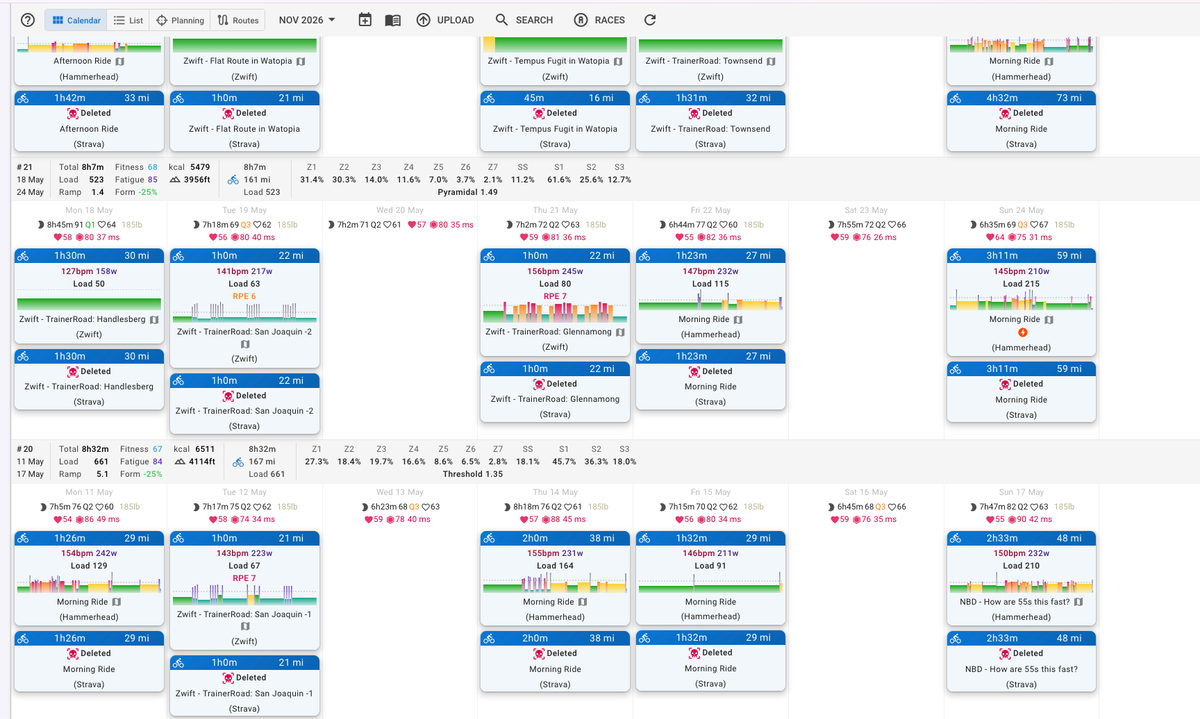
Detecting real overload in outdoor data is genuinely hard — the noise is enormous. But laid out in a table it's usually obvious. Three sessions of 2x20 at 300, then 3x15 at 290, then 3x20 at 300? Clear progression in total time in zone. Five extra minutes at ten watts lower? Ambiguous as a single data point. If you have to construct an argument for why progress is technically happening, it probably isn't.
One failed workout in ten is noise. Two in four is a signal, and the signal is almost never "try harder."
Don't cram, and don't make it up
The comment I'd most like to delete from training logs: felt terrible, will try again tomorrow.
Unless you know the specific cause — you skipped lunch, you'd just flown, the heat broke overnight — tomorrow has no particular reason to be different. Whatever suppressed today's session is usually a recovery problem, and recovery problems don't resolve because you rescheduled.
Cramming works for an exam. It works poorly for a race, because the fatigue you generate compounds with fatigue you already carry, and the closer you get to the event the smaller the margin for overshooting. Reported research gives a useful humility check here too: when the same group of people was put through the same training program twice, individual improvement the first time didn't reliably predict improvement the second time. The input is one variable among many.
Volume is not a lever you pull in isolation
"If I go from 10 to 15 hours, how much FTP will I gain?"
Possibly none. Possibly less than you have now. Fifty percent more training stress with the same sleep, the same food, and the same job is a recipe for slow decay, not growth. A single big week is a nice camp and roughly two or three percent of the season's total load — it mostly buys you endurance, not threshold. Sustained higher volume across a month or two is where the real change lives, and only if you actually recover from it.
The food part gets skipped constantly. Carbohydrate intake and total calories have to scale with the hours or the hours don't produce anything.
Intensity distribution is a result, not an input
The polarized-versus-sweet-spot argument was always more entertaining than useful. Deciding in advance that you'll train polarized and then forcing time-in-zone targets to match — regardless of what your legs are reporting — is how people grind themselves into a hole with impeccable documentation.
Start somewhere else. What actually limits you in your event? Not "my FTP," which is everyone's answer and tells you nothing. If you're a crit racer getting dropped before the sprint ever happens, 200 more watts of peak power is irrelevant; you need threshold and endurance. If you've got a big engine and no repeatability, you might start brushing short repeated efforts in December for a May peak — small doses, never the hardest session of the week.
Whatever distribution emerges from that, fine. It's a useful label for post-hoc analysis and a poor planning instrument.
A related fallacy worth killing: the idea that if you can hold sweet spot for two hours, your FTP must be underestimated. Durability and threshold are only loosely coupled. Riders around 3 w/kg who race gravel and ultras can absolutely do two-plus hours at sweet spot. That's trained endurance, not a mis-set number.
When your schedule won't cooperate
Unpredictable schedules usually come bundled with short sleep, and short sleep caps how much you can absorb. The worst response is to run the plan as written and hope.
Better: move hard sessions to days you'll plausibly be recovered, accept that some weeks are 30-45 minutes of easy spinning to keep the legs from going stale, and reset the expectation from improve to hold. Holding threshold at 60-80% of normal volume through a brutal work stretch is a win, not a wasted month.
There's also a distinction worth keeping: training versus exercising. Training has a purpose and an expected outcome. Exercising is an hour outside with the head unit ignored, which is why most of us started. Both are legitimate. Just don't confuse one for the other and then be disappointed.
Perfect versus good
Two different readings of this question, both useful.
If "perfect" means flawless execution of a build block versus merely solid execution — the difference is a few percent at most, and shrinks every year you've been training. If a good year gets you ten watts and a perfect one gets eleven, the extra watt costs more anxiety than it's worth. I've seen the stress of chasing perfect execution measurably degrade recovery, which makes the plan worse, not better.
If "perfect" means a plan properly matched to your actual recovery capacity and life stress, that's different. The adjustments are usually small — shift a session, cut a day, trim volume — and over one month the difference is real but modest. Over three seasons, those decisions compound into something large.
The question that matters isn't whether you followed the plan. It's whether the plan fits the life you're actually living — and how fast you admit it when it stops fitting.
TL;DR
- Build plans around phase priorities, not a fixed sequence of sessions; when the week falls apart you'll know what to protect and what to drop guilt-free.
- Missed and failed workouts are expected, not catastrophic — don't make them up, and if progress stalls while the plan looks sound, investigate recovery before rewriting the training.
- Start from your race limiters, not from a chosen intensity distribution; polarized or pyramidal should describe what you did, not dictate it.