SILCA's Gravel Tires Use Thinner Casings on Wider Widths—Here's Why
SILCA's Protocol gravel tires flip casing logic—thinner casings on wider tires. Four models from $99. Here's what the specs actually mean for your next race.


SILCA built its reputation on pumps and tire pressure calculators. Now it makes the tires themselves. The Protocol gravel line launched August 20 with four models—RCG-1 through RCG-4—each targeting a different slice of the gravel spectrum, all at a flat $99 per tire.
The engineering logic runs counter to industry trends. As gravel tires got wider, most manufacturers added rubber and thickened casings. SILCA went the opposite direction: their widest tires carry the thinnest casings. The physics argument is straightforward. At lower pressures, casing threads hold less tension. Less tension means the material deflects on impact rather than slicing through. It's why the 55mm options can run a 120 TPI casing and still claim better puncture resistance than heavier alternatives. Whether that holds up across thousands of mixed-surface miles is the real test—casing theory and casing durability aren't always the same conversation.
The lineup splits cleanly. RCG-1 (460–535g depending on width) targets hardpack and pavement-heavy races—think Mid South or Gravel Worlds. Near-slick center, side knobs for cornering. RCG-3 (495–590g) is the all-rounder for courses like Unbound where conditions vary. RCG-4 (545–650g) goes full aggressive with widely spaced lugs for mud and technical terrain. There's also a 32-inch RCG-3 variant at 710g for riders running that wheel standard.
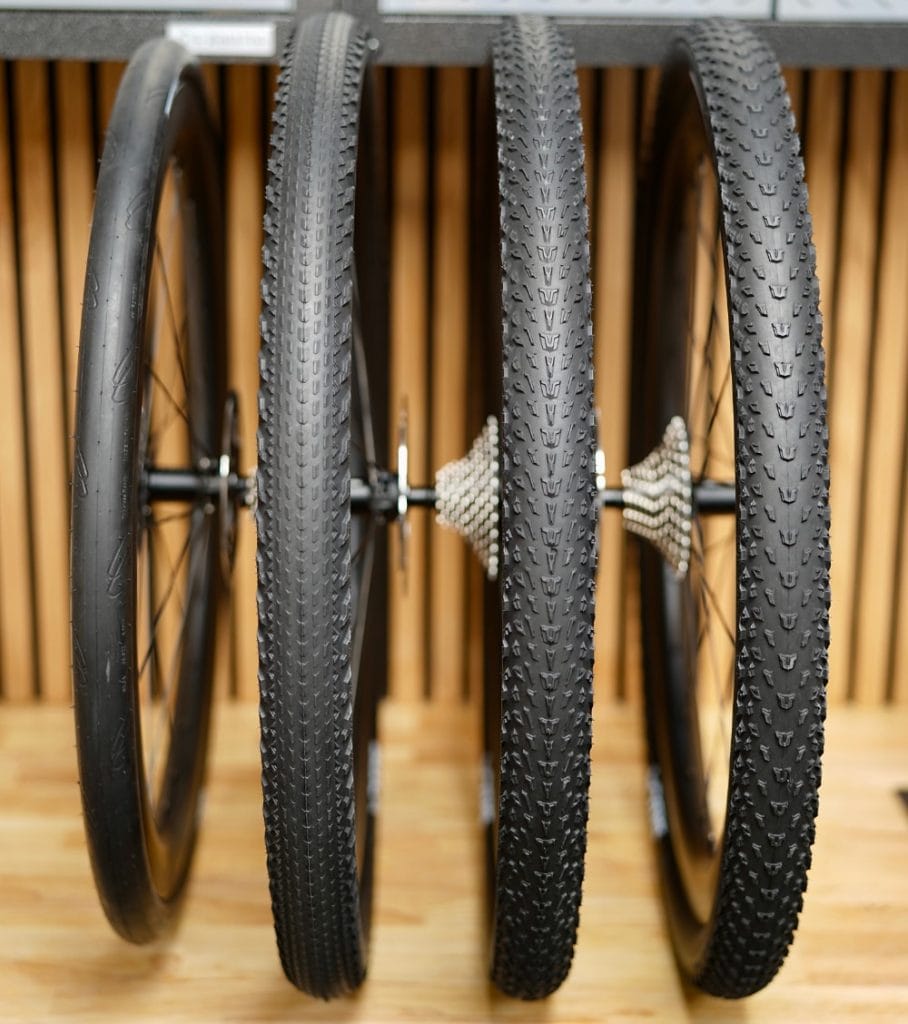
Carbon fiber beads replace Kevlar across the line. The claimed benefit: no stretch, no moisture absorption, no bead deformation over time. The Pulsar compound—solution-polymerized styrene butadiene rubber with silica reinforcement—aims to cut rolling resistance without sacrificing grip. On the tread designs, outer blocks sit taller than center knobs, engaging earlier at moderate lean angles.
For the data-driven rider, this is interesting precisely because SILCA has skin in the pressure game. They've spent years telling people what PSI to run; now they're building casings around that research. The $99 price point undercuts some competitors while matching others. The question isn't whether the theory is sound—it's whether a pump and tool company can execute on tire manufacturing at scale. If you're racing gravel on a budget and want to bet on SILCA's casing logic, the RCG-3 in your clearance-appropriate width is probably the place to start. If you need proven durability data before committing, these are too new to have it.