The Floor is Lava: Why the 2026 Vuelta is Heading South
A deep dive into the 2026 Vuelta a España route. Analysis of the 58,000m elevation gain, the move to the southern heat, and why this is a versatile sprinter's dream.

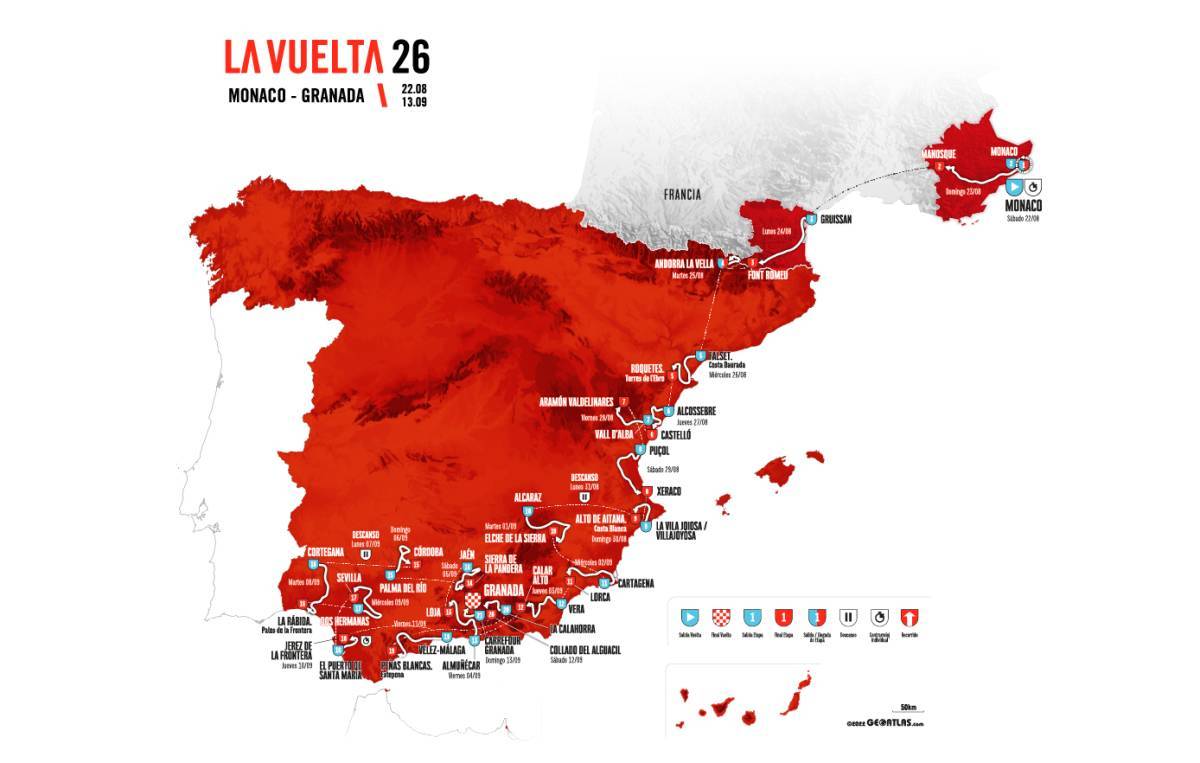
The 2026 Vuelta a España route has finally been unveiled, and looking at the map, there is one word that keeps coming to mind: Lava.
I’ve spent the morning pouring over the profiles, and it feels like a deliberate departure from the traditional Spanish tour geography. By starting in Monaco and then immediately diving into the deep south, the organizers have essentially declared the entire northern half of the country—the lush Basque Country, Asturias, and Galicia—to be "lava." They are staying away from the cooler, damp climbs of the north and leaning head-first into the furnace of Andalusia and Murcia.
The Geography of Heat
There is a distinct political and environmental "heat map" to this route. We are looking at a race that spends roughly 70% of its time in the south during August and September. To put that in perspective, cities like Sevilla and Granada frequently see temperatures north of 40°C (104°F) during this window.
It’s a risky gamble. We’ve seen stages in the past where riders were visibly wilting, not from the gradients, but from the sheer thermal stress. While the organizers claim this is the "hardest route of the year" with 58,000 meters of elevation gain, the invisible opponent will be the sun.
A Polarized Parkour
This isn't your typical Vuelta. Usually, the race is famous for the Unipuerto—the "one-climb" stage where it’s flat all day followed by a 15-minute explosion up a steep goat path. This year feels different. It’s polarized.
- The Hidden Vert: There is an immense amount of "hidden" climbing. Even the stages that look like sprints on a low-res profile are packed with 3,000+ meters of elevation.
- The Versatile Sprinter's Dream: Because many of the flat stages feature a Category 3 ramp within the final 20 kilometers, pure speedsters like Jonathan Milan might find the time limits more threatening than the finish lines. This route screams for versatile powerhouses—guys like Mads Pedersen or Biniam Girmay who can survive a 6% "bump" and still kick.
- The Gravel Wildcard: Stage 6 features a nasty surprise: a gravel segment on a 9-kilometer climb (7.2% average) with ramps hitting 11%. It’s the kind of "no risk, no glory" terrain where Primož Roglič usually thrives.
The GC Battlefield: High Peaks and High Stakes
If you’re looking for the day the race is won, circle Stage 20. It’s a monster: 5,203 meters of climbing over 187 kilometers. It’s a "medium mountain festival" that never stops. There isn't a single Alpine-style 20km steady climb; instead, it’s a relentless series of "walls" that favor the explosive climbers.
Key Contenders to Watch:
- Tadej Pogačar: As the saying goes, "Every route is a Pogačar route." His improved heat tolerance makes him the heavy favorite if he starts.
- Adam Yates & Richard Carapaz: Both men have historically excelled in the thin, hot air of the Spanish south.
- The "Home" Advantage: With the race hitting Andorra in Stage 4, keep an eye on the resident pros like Mattias Skjelmose. Knowing every corner of a technical descent like the Coll d'Ordino is worth its weight in gold.
Final Reflections
Is it a "good" route? It’s a Joaquin Phoenix of a route—unconventional, slightly intense, and potentially a masterpiece if the right actors show up. While I’ll miss the mist of the Angliru, there is something thrilling about a Grand Tour that fully embraces the chaos of the southern heat and technical gravel.
I’m already thinking about where to watch Stage 4 in Andorra. Perhaps I’ll find a spot near the Alto de la Comella and see if the local knowledge of the peloton's "tax exiles" actually pays off.